


Every Rails project accumulates gems over time. The difference between a maintainable Gemfile and dependency hell comes down to choosing tools that solve real problems without introducing unnecessary complexity. After 15+ years of Rails development, these 10 gems consistently earn their place in production applications.
What makes a gem worth adding to your Gemfile?
Three criteria matter: active maintenance, minimal transitive dependencies, and a clear single responsibility. A gem that solves one problem well beats a Swiss-army-knife library every time. Each gem below passes all three tests.
| Gem | Purpose | Why it earns its place |
|---|---|---|
| Pry | Interactive debugging | Replaces IRB with runtime inspection and live code editing |
| Devise | Authentication | Pre-built flows with secure defaults, saves weeks of work |
| RSpec | BDD testing | Readable syntax, powerful matchers, parallel execution |
| RuboCop | Code quality | Automated style enforcement, auto-correct, CI integration |
| FactoryBot | Test data | Dynamic factories replace brittle YAML fixtures |
| Sidekiq | Background jobs | Multithreaded Redis-based processing, built-in web UI |
| Kaminari | Pagination | Database-level LIMIT/OFFSET, minimal setup |
| ActiveAdmin | Admin dashboards | CRUD + filters + batch actions from a single DSL |
| CarrierWave | File uploads | Object-oriented uploaders with cloud storage support |
| Rdkafka | Kafka integration | High-performance streaming via librdkafka C bindings |
Top 10 Must-Know Ruby on Rails Gems for Developer | #RailsGems #RubyOnRails #DevTips #RubyGems #ROR
Why does Pry replace IRB in every serious Rails project?
IRB gives you a REPL. Pry gives you a debugger, documentation browser, and code explorer in one tool. Drop binding.pry anywhere in your code, and execution pauses at that exact point.
Key capabilities:
- Live code editing - modify variables, redefine methods, test alternative paths without restarting
- Object navigation -
lslists methods,cddrills into objects,show-sourcereveals implementations - History search -
hist --grepfinds debugging techniques from past sessions - Custom prompts - display Git branch, Rails environment, or database connection status
With pry-rails, your rails console launches with Pry by default. Add pry-byebug for step-through debugging in controllers and models. ActiveRecord queries display with execution times, making it easy to spot N+1 problems without jumping between log files.
How does Devise save weeks of authentication work?
Building authentication from scratch takes 2-3 weeks minimum. Devise gives you registration, login, password recovery, session management, and email confirmation out of the box.
# Two commands to full authentication
rails generate devise:install
rails generate devise User
This creates migrations, routes, controllers, and views automatically. The devise.rb initializer controls session timeouts, password complexity, and email settings:
config.timeout_in = 30.minutes
config.password_length = 8..128
Devise integrates with Rails I18n for multilingual error messages and form labels. Standard helpers like before_action :authenticate_user!, current_user, and user_signed_in? keep controller code clean and consistent.
For testing, built-in RSpec helpers like sign_in user eliminate manual authentication simulation.
What makes RSpec the default testing choice for Rails?
RSpec tests read like specifications. Descriptions like describe "when user is authenticated" and it "returns user's posts" serve as living documentation that evolves with your codebase.
Time-saving features:
- Focused testing -
fitorfdescriberuns only specific tests during development - Shared examples - define common behaviours once, reuse across models with
it_behaves_like "auditable" - Rails matchers -
be_valid,have_many(:posts),validate_presence_of(:email)for expressive assertions - Parallel execution - run tests across multiple CPU cores for large suites
RSpec’s rspec-rails gem integrates with transactional fixtures, rolling back database changes after each test. Detailed failure reports with stack traces and line-by-line diffs make debugging fast.
How does RuboCop prevent code quality decay?
Code style debates waste team time. RuboCop ends them by automating enforcement of the Ruby Style Guide.
# Fix formatting automatically
rubocop --auto-correct

# Handle complex issues like method length
rubocop --auto-correct-all

# Check only changed lines in pre-commit hooks
rubocop --diff
Configure rules in .rubocop.yml to match your team’s conventions. The rubocop-rails extension adds framework-specific cops for ActiveRecord optimization, callback patterns, and security risks. Add rubocop-rspec for test-specific style checks.
With --parallel, RuboCop uses multiple CPU cores for faster analysis in CI pipelines.
Why do factories beat fixtures for test data?
YAML fixtures create hidden dependencies between tests. FactoryBot factories generate isolated, dynamic test data on demand.
# Base factory with traits
factory :user do
  name { "John" }
  email { Faker::Internet.email }

  trait :admin do
    role { :admin }
  end

  trait :with_profile do
    after(:create) { |user| create(:profile, user: user) }
  end
end

# Compose traits as needed
create(:user, :admin, :with_profile)
Build strategies control database interaction:
build- in-memory only (fastest)create- persisted to databasebuild_stubbed- mimics saved records without touching the databaseattributes_for- returns attribute hash for controller tests
Factory inheritance and associations handle complex object graphs automatically. FactoryBot creates parent records before children, respects ActiveRecord validations, and catches invalid factory definitions immediately.
When should you reach for Sidekiq?
Any operation that takes more than 200ms belongs in a background job. Email delivery, image processing, report generation, API calls to external services: all of these block the request cycle and degrade user experience.
Sidekiq processes jobs concurrently using threads (not processes), keeping memory usage low. A single Sidekiq process handles dozens of jobs simultaneously.
# Schedule a job with delay
MyWorker.perform_in(1.hour, user_id)
Key features:
- Redis-backed queuing with persistence across restarts
- Built-in web UI for real-time queue monitoring
- Automatic retries with exponential backoff
- ActiveJob integration for standard Rails job syntax
How does Kaminari handle pagination without complexity?
Loading thousands of records kills response times. Kaminari adds database-level pagination with one method call:
@users = User.page(params[:page]).per(25)This generates LIMIT and OFFSET SQL, never loading more records than needed. Built-in view helpers create navigation controls automatically.
For APIs, helper methods like current_page, total_pages, and total_count provide JSON-friendly pagination metadata. Kaminari works with PostgreSQL, MySQL, and SQLite, respects model scopes and associations, and integrates with Rails caching.
What can ActiveAdmin generate in one line of code?
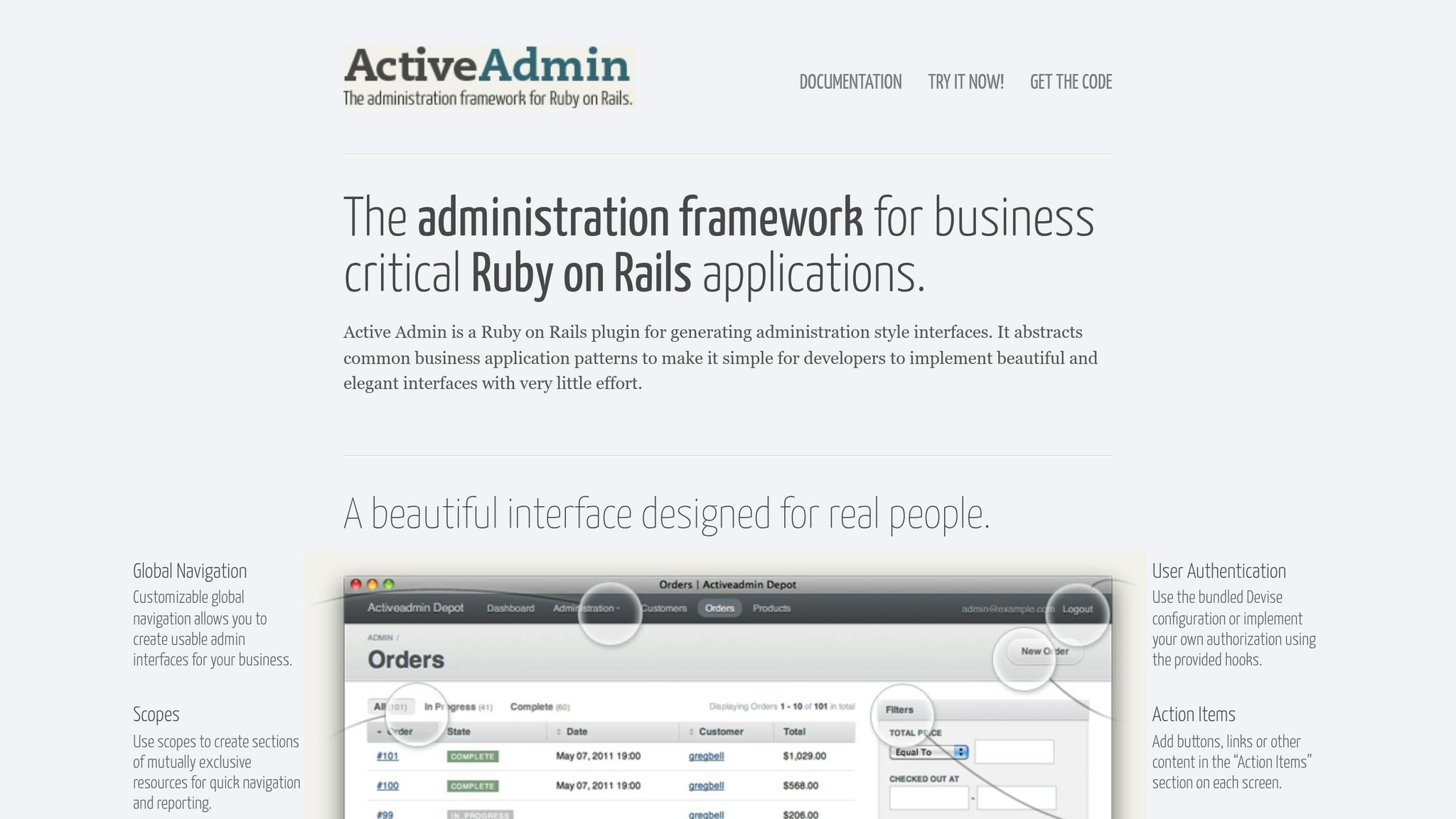
A single registration creates a full admin interface:
ActiveAdmin.register ProductThis gives you CRUD operations, search, filters, pagination, and CSV export. The DSL supports batch actions for bulk operations, custom dashboards with widgets and charts, and Devise integration for admin authentication.
ActiveAdmin runs as a Rails engine, supporting Rails 7 and 8 with strong parameters, model associations, and caching. For compliance-heavy applications, it logs administrative actions and tracks data changes.
How does CarrierWave keep file handling clean?
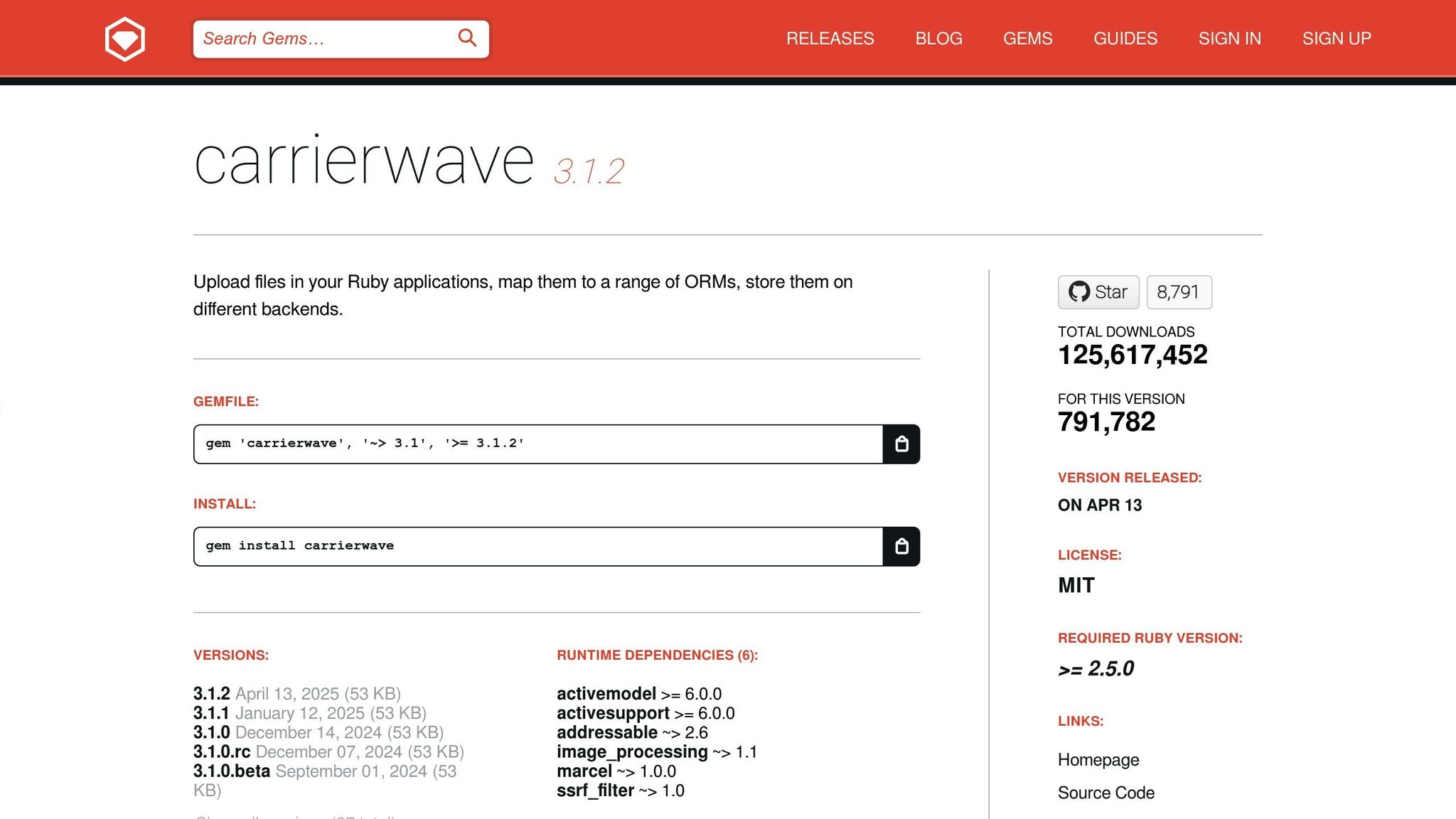
File upload logic scattered across controllers creates maintenance nightmares. CarrierWave encapsulates everything in uploader classes that follow the single-responsibility principle:
- Automatic versioning - generate thumbnails and variants after upload
- Built-in validation - check file size, format, and content type
- Filename sanitization - ensure security across operating systems
- Cloud storage - switch to S3 or Google Cloud with configuration only
Mount an uploader to any ActiveRecord model with one declaration. CarrierWave handles file paths, directory creation, and cleanup. It works with background job processors for async file processing.
When does Rdkafka make sense in a Rails app?
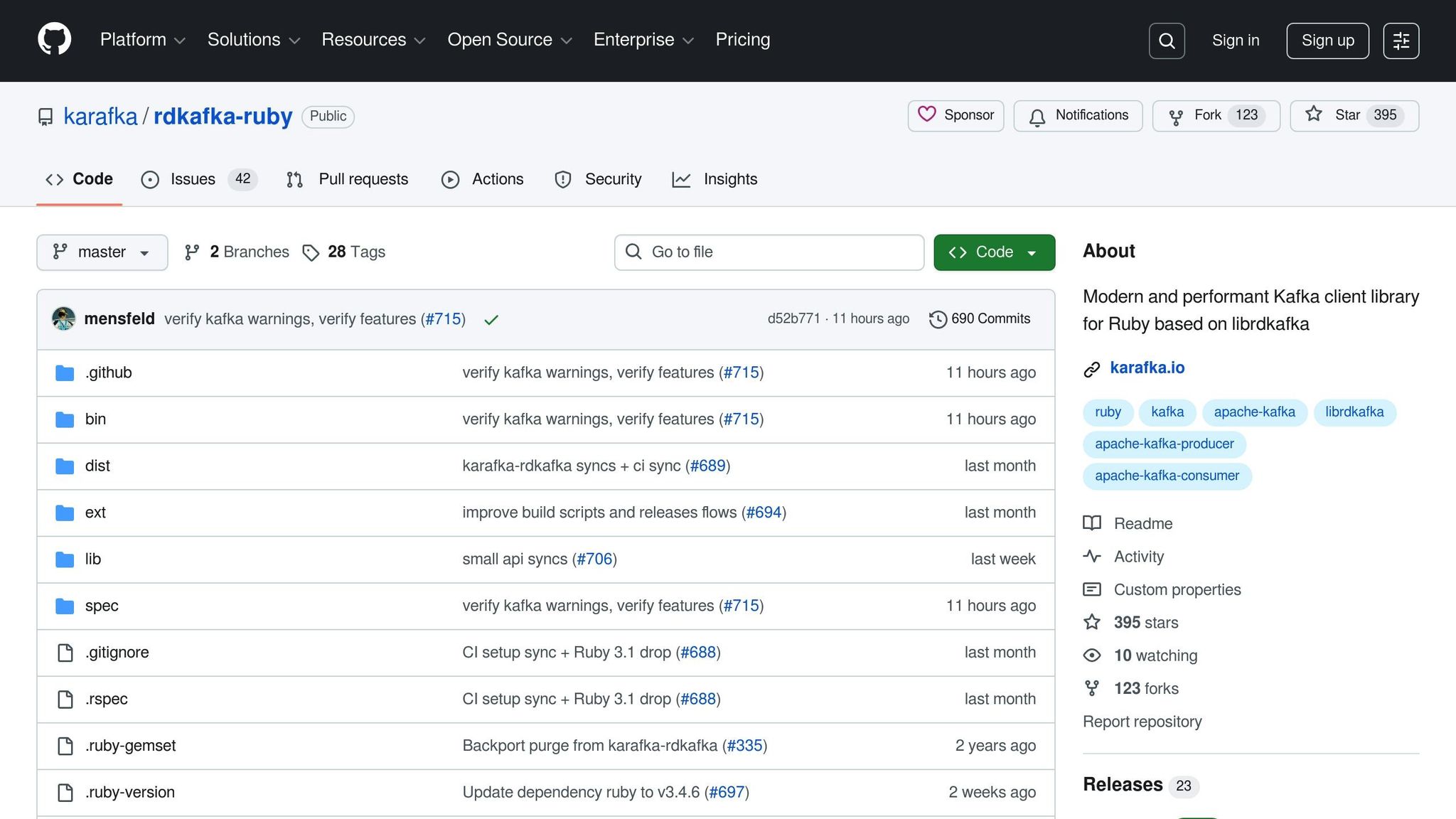
When your application needs high-throughput event streaming or microservice communication, Rdkafka provides Ruby bindings to the battle-tested librdkafka C library.
Use cases:
- Real-time data pipelines between services
- Event sourcing architectures
- High-volume log aggregation
- Distributed system communication
Rdkafka offers synchronous and asynchronous message processing, automatic retries, thread-safe initializers compatible with Rails startup, and built-in metrics for throughput monitoring. Its producer and consumer classes follow Ruby conventions, keeping Kafka integration logic isolated from business code.
Practical Implementation: The USEO Approach
Gem selection in isolation means little. What matters is how gems interact in a production stack and how they behave under real-world load over years of operation.
On the Yousty HR portal, a partnership spanning 13 years, we built the testing infrastructure around RSpec + FactoryBot + SimpleCov from the earliest versions. Over time, the test suite grew to thousands of specs covering complex Swiss employment workflows. Sidekiq handles background processing for job matching notifications and document generation. The key lesson: investing in comprehensive factory definitions early pays dividends for years. When Yousty’s business rules changed, we updated factories and caught cascading issues across the test suite immediately.
For Triptrade, a travel platform MVP, we prioritized speed to market. Devise handled authentication with custom OAuth flows for travel provider APIs. CarrierWave managed user-uploaded travel documents with S3 storage. Kaminari paginated search results across thousands of travel offers. The constraint was build time: by leveraging these proven gems instead of custom implementations, we delivered a working MVP in weeks rather than months.
Gem compatibility matrix we maintain:
| Stack concern | Primary gem | Backup/Alternative | When to switch |
|---|---|---|---|
| Auth | Devise | Rodauth | When you need database-level security |
| Background jobs | Sidekiq | GoodJob | When you want to avoid Redis dependency |
| Testing | RSpec | Minitest | For library/gem development |
| File uploads | CarrierWave | ActiveStorage | For simple attachment needs |
| Admin | ActiveAdmin | Administrate | When you need more customization |
The pattern we follow: start with the established gem, measure its performance in your specific context, and only switch when you hit a concrete limitation. Premature optimization of your gem stack wastes time that should go into building product features.
FAQs
How do I evaluate whether a gem is safe to add to my project?
Check three things: last commit date (should be within 6 months), number of open issues vs. closed issues (healthy ratio indicates active maintenance), and transitive dependencies (fewer is better). Run bundle audit regularly to check for known vulnerabilities in your gem dependencies.
Can these gems work together without conflicts?
Yes. These 10 gems are designed to integrate with Rails conventions and rarely conflict with each other. RSpec + FactoryBot + RuboCop form a natural testing trio. Devise + ActiveAdmin share authentication seamlessly. Sidekiq works with any gem through ActiveJob’s adapter pattern.
What is the best order to introduce these gems into a legacy project?
Start with RuboCop to establish code standards, then add RSpec for test coverage. Once you have tests, introduce FactoryBot to replace fixtures. Devise and Sidekiq come next for core infrastructure. Kaminari, ActiveAdmin, and CarrierWave address specific feature needs as they arise.